Writer-activist Arundhati Roy’s recent polemic on Maoism, development and governance has angered many in the UPA government, but the Prime Minister, Dr Manmohan Singh’s daughter, Ms Daman Singh, thinks that her writings are an ‘eye-opener’.
Talking to mediapersons at the sidelines of the Kovalam literary festival here, Ms Singh said: “She is a powerful writer and her writings are an eye-opener. I usually follow all her writings in popular magazines. She has a unique and powerful way of presenting things.”
When asked whether she agreed with Ms Roy’s take on Maoism and her fierce attack on the Centre, Ms Singh quipped, “I agree with some of her views and disagree with others.”
Full report here Deccan Chronicle
Showing posts with label Daman Singh. Show all posts
Showing posts with label Daman Singh. Show all posts
Monday, October 4, 2010


Sunday, October 3, 2010
In the voice of a child, she writes
Writer and daughter of prime minister Manmohan Singh, Daman Singh, presents her book The Sacred Grove in a Q&A format, at the Kovalam Literary Fest. “Since no one is willing to share stage with me, I am going to ask questions and answer them myself,” she says.
 “Why did I write this book?” is her first question to herself.
“A couple of years ago, I wondered what I should write about, with my first book staying in my shelf, still unpublished. I decided to write about something I felt strongly about. Parenting is one such subject. My son Rohan is at a stage where he was watching me as I was watching him. I didn’t want him to pick up my faults. We all have prejudices. Initially I thought to write in the voice of a parent. But then I decided to write in the voice of a child. So I wrote about 12-year-old Ashwin whose passion is cricket.”
She poses her second question as ‘telling more about Ashwin’. “Ashwin is a boy who does not care much for studies. He sees school as a way to play cricket. He believes everyone exists in the world to please him. He used to take his mother’s word as the gospel truth. But as he begins to watch her closely, he is not sure if he likes what he sees,” says Daman.
Full report here Yentha
“A couple of years ago, I wondered what I should write about, with my first book staying in my shelf, still unpublished. I decided to write about something I felt strongly about. Parenting is one such subject. My son Rohan is at a stage where he was watching me as I was watching him. I didn’t want him to pick up my faults. We all have prejudices. Initially I thought to write in the voice of a parent. But then I decided to write in the voice of a child. So I wrote about 12-year-old Ashwin whose passion is cricket.”
She poses her second question as ‘telling more about Ashwin’. “Ashwin is a boy who does not care much for studies. He sees school as a way to play cricket. He believes everyone exists in the world to please him. He used to take his mother’s word as the gospel truth. But as he begins to watch her closely, he is not sure if he likes what he sees,” says Daman.
Full report here Yentha
Indo-Anglian writing has come of age: Daman Singh
Indian writing in English has come of age, offering an exciting world of stunning works to readers across the world, said noted writer Daman Singh.
 Ms. Singh, who was here to participate in the third edition of the two-day Kovalam Literary Festival, told reporters on Saturday evening that Indian writing in English catered to a wide spectrum of readers across the world and had produced brilliant writers with enormous appeal like Salman Rushdie and Vikram Seth. Many have won international acclaim, like Arundhathi Roy who has a very powerful style. Their books are being published abroad too. “We have been reading foreign books, but now there are diverse kinds of works and it is really exciting,” she said.
Ms. Singh is getting ready for extensive research to write a personal biography of her father, Prime Minister Manmohan Singh, and their family. “It is not a political biography, but a personal one.”
The book will require thorough research and would take time. Ms. Singh said she has great faith in her father and is sure that the policies being pursued by him will lead the nation in the right course of development and prosperity. “The signs are really encouraging. The needs of the common man are being met.” The policies and programmes have pulled India out of a grave economic crisis and put it on the path of growth.
Full report here Hindu
Ms. Singh is getting ready for extensive research to write a personal biography of her father, Prime Minister Manmohan Singh, and their family. “It is not a political biography, but a personal one.”
The book will require thorough research and would take time. Ms. Singh said she has great faith in her father and is sure that the policies being pursued by him will lead the nation in the right course of development and prosperity. “The signs are really encouraging. The needs of the common man are being met.” The policies and programmes have pulled India out of a grave economic crisis and put it on the path of growth.
Full report here Hindu
I have faith in my father: Daman Singh
As more questions on politics come up, Daman insists that she has no interest in politics
 Daman Singh is in the city to attend the third edition of the Kovalam Literary Fest at the Kanakunnu Palace here. Flooded with questions on her father’s work, the daughter of prime minister Manmohan Singh tells with a smile “I have faith in my father.”
“I am afraid I am not an economist. I am not qualified to answer the questions on government policies. However, I believe that the path that he (Manmohan Singh) has put India on is the right one,” she says.
Asked about one signal contribution that the prime minister made to India, she says: “He has pulled India out of a very grave economic crisis, with the help of others. He has put the country on the path of growth. Since it has been able to achieve growth, India could also make investments in the development of health, education etc. We have changed from a low-growth economy to a high-growth economy.”
Full report here Yentha

“I am afraid I am not an economist. I am not qualified to answer the questions on government policies. However, I believe that the path that he (Manmohan Singh) has put India on is the right one,” she says.
Asked about one signal contribution that the prime minister made to India, she says: “He has pulled India out of a very grave economic crisis, with the help of others. He has put the country on the path of growth. Since it has been able to achieve growth, India could also make investments in the development of health, education etc. We have changed from a low-growth economy to a high-growth economy.”
Full report here Yentha
PM's daughter wins over readers at Kerala fest
Far from the dazzle of the Commonwealth Games opening ceremony in Delhi, Prime Minister Manmohan Singh's writer-daughter Daman Singh charted a different course as she interacted with a galaxy of writers, readers and the media in freewheeling chats at the Kovalam Literary Festival here on Sunday, Oct 3.
The writer, who arrived in rain-washed city Saturday with son Rohan and a posse of security men, said "she has not inherited her gift for words from her father".
Daman Singh read out excerpts from her book, "The Sacred Grove", and fielded questions from the audience at an interactive session on Sunday.
Full report here Times of India
The writer, who arrived in rain-washed city Saturday with son Rohan and a posse of security men, said "she has not inherited her gift for words from her father".
Daman Singh read out excerpts from her book, "The Sacred Grove", and fielded questions from the audience at an interactive session on Sunday.
Full report here Times of India
PM’s daughter supports Arundhati
Prime Minister Manmohan Singh’s daughter Daman Singh feels that the essays of writer-activist Arundhati Roy who has been attacking the Government’s Maoist and other policies are an ‘eye-opener’.
“I follow all her writings in popular magazines. She is a powerful writer and her writings are an eye-opener. She has a unique and powerful way of presenting things,” Daman Singh told newsmen on the sidelines of the Kovalam literary festival here.
When asked whether she agreed with Roy’s views on Maoism and her fierce attack on the government, Daman said, “I agree with some of them and disagree with others.”
Book on parents
Author of the novel Nine by Nine, 46-year-old Daman Singh was in the capital to present her second work Sacred Grove. She said her next work would be a “personal biography” of her parents in which she will present various aspects of their life. Of course, she can’t be critical of them either.
Full report here Deccan Herald
“I follow all her writings in popular magazines. She is a powerful writer and her writings are an eye-opener. She has a unique and powerful way of presenting things,” Daman Singh told newsmen on the sidelines of the Kovalam literary festival here.
When asked whether she agreed with Roy’s views on Maoism and her fierce attack on the government, Daman said, “I agree with some of them and disagree with others.”
Book on parents
Author of the novel Nine by Nine, 46-year-old Daman Singh was in the capital to present her second work Sacred Grove. She said her next work would be a “personal biography” of her parents in which she will present various aspects of their life. Of course, she can’t be critical of them either.
Full report here Deccan Herald
Monday, August 23, 2010
Adults deconstructed
You know you want to read a book when you are laughing out loud by the time you turn the first page. That is what Daman Singh's The Sacred Grove does. It is a story of the rise of the ugly face of India's communal divide from the point of view of Ashwin, a 12 year old and son of a bureaucrat in a town where decent folks live. It is also a rites of passage story about how a young boy thinks, feels, reacts, and how we adults impose our own biases on our children.
The book is mostly interior monologue and quite like The Curious Incident of the Dog in the Night Time, we participate in the story from a space where the responses to the situations is on the lines of: I like, I dislike, okay that, well fine ... Ashwin's wry humour and dead-pan narration holds the reader. Throughout the book there is not a single sentence, word or punctuation that is not the voice of the narrator. The author speaks completely through her character and the character always stays in his role. Showing a story and not telling it is a rare feat to handle. Daman has done very well.
...when Sarita Ma'am told us to turn to Page 63, I got a shock on my life. There was a slice of a man, completely naked, with his thing hanging sadly down for all of us to study. Nothing private about it at all. In the beginning reproduction was about a fat amoeba squeezing into two daughter cells. Then bread mould sending up antennae which burst into millions of spores. And flowers, which were okay too. ... Now it was the turn of humans. Our turn. Luckily there were no practicals. Naturally Varun was disappointed. He was just a kid, not like the rest of us.
Full report here Businessworld
 |
| The Sacred Grove Daman Singh HarperCollins Rs 299; Pp 248 |
...when Sarita Ma'am told us to turn to Page 63, I got a shock on my life. There was a slice of a man, completely naked, with his thing hanging sadly down for all of us to study. Nothing private about it at all. In the beginning reproduction was about a fat amoeba squeezing into two daughter cells. Then bread mould sending up antennae which burst into millions of spores. And flowers, which were okay too. ... Now it was the turn of humans. Our turn. Luckily there were no practicals. Naturally Varun was disappointed. He was just a kid, not like the rest of us.
Full report here Businessworld
Friday, August 20, 2010
Bookshelf spills economics, underworld, god
As the weather slides and more clouds threaten to burst, retreat with a book and a cup of coffee. The mixed bag this week...
1. 'Superpower? The Amazing Race Between China's Hare and India's Tortoise': Written by Raghav Bahl; Published by Penguin-Books India; Priced at Rs.699.
With telling insights into the two Asian powers' histories, polities, economies and cultures, the book probes the difference between the way India and China have built their economic foundations. It shows that even as the dragon and elephant economies are together projected to dominate the world in a matter of decades, there is a palpable difference in the way China and India work on the ground.
China is spectacularly effective in building infrastructure and is currently investing almost half of its GDP; it is crafting a new economic idiom that has stood textbook wisdom on its head. Meanwhile, India is the classic example of a 'promising' economy: more than half of its GDP is consumed by its billion-plus population.
2. 'Sacred Grove': Written by Daman Singh; Published by HarperCollins-India; Priced at Rs.200.
Master of jingles, aspiring Bay-blader and star cricketer on home ground, Ashwin is smart, funny, and sometimes bratty beyond belief. As the son of the district collector in a small town in central India, he has little to worry about except his mother's mood swings, his father's principles and an about-to-be-born sibling. And yes, his Masi's occasional visits, not always with a gift in hand.
Full report here Sify
1. 'Superpower? The Amazing Race Between China's Hare and India's Tortoise': Written by Raghav Bahl; Published by Penguin-Books India; Priced at Rs.699.
With telling insights into the two Asian powers' histories, polities, economies and cultures, the book probes the difference between the way India and China have built their economic foundations. It shows that even as the dragon and elephant economies are together projected to dominate the world in a matter of decades, there is a palpable difference in the way China and India work on the ground.
China is spectacularly effective in building infrastructure and is currently investing almost half of its GDP; it is crafting a new economic idiom that has stood textbook wisdom on its head. Meanwhile, India is the classic example of a 'promising' economy: more than half of its GDP is consumed by its billion-plus population.
2. 'Sacred Grove': Written by Daman Singh; Published by HarperCollins-India; Priced at Rs.200.
Master of jingles, aspiring Bay-blader and star cricketer on home ground, Ashwin is smart, funny, and sometimes bratty beyond belief. As the son of the district collector in a small town in central India, he has little to worry about except his mother's mood swings, his father's principles and an about-to-be-born sibling. And yes, his Masi's occasional visits, not always with a gift in hand.
Full report here Sify
Monday, August 16, 2010
My childhood has crept into my book: PM's daughter
Daman Singh, the novelist daughter of Prime Minister Manmohan Singh, says her new book is about lost innocence and how childhood as an experience has changed over the years. Hers certainly was different from that of today's GenY, she says.
Daman Singh, whose second novel The Sacred Grove (HarperCollins-India) is just out, says some of her "childhood impressions" have crept into her work.
"I think today's child lives in a world that is very different from the one I knew as a child," Daman Singh told IANS in an interview. "The explosion of information, the vast opportunities, the access to technology: these are things I did not experience when I was young.
"But still, some things remain the same...like relationships with family and friends, the confusion of teenage years, the desperate need for unconditional love and respect. So some of my own childhood impressions do find their way into The Sacred Grove," said Daman Singh, whose novel was released last week.
Full report here Economic Times
Daman Singh, whose second novel The Sacred Grove (HarperCollins-India) is just out, says some of her "childhood impressions" have crept into her work.
"I think today's child lives in a world that is very different from the one I knew as a child," Daman Singh told IANS in an interview. "The explosion of information, the vast opportunities, the access to technology: these are things I did not experience when I was young.
"But still, some things remain the same...like relationships with family and friends, the confusion of teenage years, the desperate need for unconditional love and respect. So some of my own childhood impressions do find their way into The Sacred Grove," said Daman Singh, whose novel was released last week.
Full report here Economic Times
Friday, July 23, 2010
An idyll that ends in a nightmare
A game of cricket in the lawns of his house confronts the narrator of this novel, Ashwin, a 12-year-old boy with a dilemma. He has to answer at that very moment whether he is still a child. “No, I am not”, is Ashwin’s defiant response. Thus the story takes off.
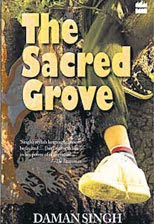 The Sacred Grove is set in a small Indian town where Ashwin’s father is the district collector. Thanks to the government, as Ashwin says, they had the best house in town and it was not much of a town any way, with three main roads and no red lights. But Ashwin liked the town; it had heart, it had soul, people believed in the same things. That was what Ashwin and the driver Rafiq thought.
Though there is an inconsequential temporal sequence in the book, it is Ashwin who decides which incidents in his life he wants the reader to know. He chooses as he pleases and his concern is with the “here and now” told in the language that he speaks.
The story begins with Ashwin’s mother’s unexpected pregnancy. When his father tries to explain it to him, Ashwin is dismissive because he has learnt all that he needed to learn about reproduction in school. The narration continues with Ashwin’s triumphs in computer games and cricket, he describes his humiliation in football with unflinching honesty when he manages to kick the ball into his own goal. “My life stank. I wanted to die.” Ashwin is the urban middle-class everyboy.
Full report here Deccan Chronicle

Though there is an inconsequential temporal sequence in the book, it is Ashwin who decides which incidents in his life he wants the reader to know. He chooses as he pleases and his concern is with the “here and now” told in the language that he speaks.
The story begins with Ashwin’s mother’s unexpected pregnancy. When his father tries to explain it to him, Ashwin is dismissive because he has learnt all that he needed to learn about reproduction in school. The narration continues with Ashwin’s triumphs in computer games and cricket, he describes his humiliation in football with unflinching honesty when he manages to kick the ball into his own goal. “My life stank. I wanted to die.” Ashwin is the urban middle-class everyboy.
Full report here Deccan Chronicle
Subscribe to:
Posts (Atom)